Wednesday, 14 December 2011

Thurs Dec 16th More Constructions

LEARNING OBJECTIVE: To practise drawing skills using straight edge, pencil and ruler make accurate Constructions

SUCCES CRITERIA: You will be able to accurately construct the following

Triangles

Triangle Centers

Circles, Arcs and Ellipses

LESSON: Work through the constructions by demonstrating them and then given students a chance to have a go at them

PLENARY: Checking answers walking around room / supporting students who are struggling.

Exam Questions: Use these questions with 25 mins to go as a 'test' to be handed ion an marked.

Monday, 12 December 2011

Tues Dec 13th / Weds Dec 14th - Constructions

LEARNING OBJECTIVE: To practise drawing skills using straight edge, pencil and ruler make accurate Constructions

SUCCES CRITERIA: You will be able to accurately construct the following

DEFINITION

Constructions: The drawing of various shapes using only a compass and straightedge or ruler. No measurement of lengths or angles is allowed.

STARTER: Can you draw a hexagon using just a compass and a ruler – NO MEASURING OF ANY KIND ALLOWED

Watch this Video for an Answer

LESSON: Work through the list of constructions above, show how to do the construction on the IWB< Get students to follow step by step then give them a few minutes to practise. Repeat with as many constructions as possible within the lesson.

Table of Contents

EXTENSION: If anyone is very good and needs some extension material get them to draw the inscribed and/or circumscribed circle for any triangle

Wednesday, 7 December 2011

Using Scale Drawings and bearings to solve problems

LEARNING OBJECTIVE: To use scale drawings of real situations to solve problems

SUCCESS CRITERIA: You will be able to construct a scale drawing of a journey; including bearings and then using measuring equipment (Protractor and ruler) solve problems

STARTER: To be completed on a piece of A4 paper

A plane flies 250 kms on a bearing of 155° then flies a further 350kms on a bearing of 85°. Draw a scale drawing of this journey and then use a ruler and protractor to answer the following questions:

  1. What is the best scale to use to fit this on a piece of A4 paper
  2. How far is the direct journey from the start to the finishing point?
  3. What is the bearing of the direct journey
  4. What is the bearing of the direct journey from the finishing point back to the starting point

LESSON:

Continue to work through Ex 12N on page 297 of Higher Text Book

EXTENSION QUESTION: A captain makes a 2° error when working out the bearing he needs before setting off across the Atlantic from new York on his way to Lisbon in Portugal (a distance of 5500 kms) he set off on a bearing of 132° instead of a bearing of 134°. Work out how far away from his destination he will end up.

PLENARY: Checking answers around the room, discussions as a class, feedback on confidence, exam question

Tuesday, 6 December 2011

Weds – Using Scale Drawings and bearings to solve problems

LEARNING OBJECTIVE: To use scale drawings of real situations to solve problems

SUCCESS CRITERIA: You will be able to construct a scale drawing of a journey, including bearings and then using measuring equipment (Protractor and ruler) solve problems

STARTER: Here is an aerial view of Heathrow airport, what is the bearing of the runway shown? What is the runaway number if this runway is seen from the other end.

Repeat for runway at Gatwick

LESSON:

Question 1

A ship sets off from Bridlington on the east coast of Yorkshire and travels in a straight line on a bearing of 065° for 80 kms.

How far due north has it gone from Bridlington, How far East has it gone from Bridlington.

Show how to draw an accurate scale drawing of the situation and then use a ruler to solve it

QUESTION 2

A plane flies 250 kms on a bearing of 155° then flies a further 350kms on a bearing of 85°. Draw a scale drawing of this journey and then use a ruler and protractor to answer the following questions:

  1. How far is the direct journey from the start to the finishing point?
  2. What is the bearing of the direct journey
  3. What is the bearing of the direct journey from the finishing point back to the starting point

Work through Ex 12N on page 297 of Higher Text Book

PLENARY: Checking answers around the room, discussions as a class, feedback on confidence, exam question

Monday, 5 December 2011

Tue 6th Dec – more practice with bearings

LEARNING OBJECTIVE: To understand and use bearings

SUCCESS CRITERIA: You will understand how to find a bearing from one place to another

STARTER: Watch this Video on finding a bearing

LESSON: Reminder of 180° rule on IWB. Use lighthouse being seen from a ship problem.

Work through Questions on page 23 of Higher text book (worksheet)

PLENARY: Checking Answers Look at a Past Exam Paper

Sunday, 4 December 2011

Mon Dec 5th – Bearings

LEARNING OBJECTIVE: To understand and use bearings

SUCCESS CRITERIA: You will understand how to find a bearing from one place to another

STARTER: Play Angler game on IWB

LESSON: Work through the lesson on Bearings. Not the last screen.

Worksheet (section 33 – Bearings),

PLENARY: Check Answers

Then work thorough Questions on page 23 of Higher text book (worksheet)

PLENARY: Checking Answers, Look at a Past Exam Paper


Tuesday, 29 November 2011

Thurs 1st Dec – Problem Solving Area and Perimeter of a circle

'LEARNING OBJECTIVE: TO use skills learned on area and perimeter of circles to solve problems

SUCCESS CRITERIA: You will be able to solve difficult problems involving area and circumference of a circle

STARTER: Have a go at Questions 10, 11 & 12 from Page 30 of Unit 3 higher text book

LESSON: Work through answers to problems on IWB.

Now try solving these wordy problems

PLENARY: Checking Answers, Discussing problems, Confidence feedback


Monday, 28 November 2011

Tues Nov 29th – Solving circle problems involving area and circumference

LEARNING OBJECTIVE: To practise solving using the circumference and area formulas to solve circle problems

SUCCESS CRITERIA: You will be able to use the area and circumference formulas to solve many different types of circle problems

STARTER: Watch this video

LESSON: Quick revision of the two formulas and the variations of the formulas, especially 'back-to-front- problems such as finding radius from circumference and finding Diameter from area.

Continue top work through the questions from higher level GCSE text book Work through Ex 11a page 245.

EXTENSION: Page 30 of Unit 3 higher text book

PLENARY: Checking answers, exam pro question to finish

Thursday, 24 November 2011

Mon Jan 28th – Area and Circumference of a circle

LEARNING OBJECTIVE: To Understand the significance of the number pi and how to use it to work out the area and circumference of a circle

S UCCESS CRITERIA: You will know what the number pi is and how to use it to solve circle problems involving area and circumference

STARTER: Can you name all these different parts and sections of a circle

PLENARY: Checking answers to Starter

LESSON:

What is pi?

Discussion on what it is, how big it is, what pi represents, rational / irrational numbers, approximations for pi.

Circle Song

Examples of Area questions and circumference questions

Work through Ex 11a page 246.

PLENARY: Check Answers, Exam Pro Questions


Wednesday, 23 November 2011

Thurs Nov 24th – Solve Problems involving Area of Parallelograms, triangles and trapeziums

LEARNING OBJECTIVE: Solve problems which need area of Triangles, Parallelograms and Trapeziums

SUCCESS CRITERIA: You will be able to solve problems involving perimeter and area of Triangles, Parallelograms and Trapeziums

STARTER: Quick reminder on How to find the area of a trapezium using the rule

A= ½ ( a + b)h    where a and b are the two sides of the trapezium that are parallel.

Start filling in this table then get students to complete it themselves


Side a

Side b

Perpendicular Height

Area

a

8 cm

4 cm

5 cm


b

10 cm

12 cm

7 cm


c

7 cm

5 cm

4 cm


d

5 cm

9 cm

6 cm


e

3 m

13 m

5 m


f

4 cm

10 cm


42 cm2

g

7 cm

8 cm


22.5 cm2

h

6 cm


5 cm

40 cm2


LESSON: Check above answers, then students to work through questions 2 onwards on page 247 of Higher Text Book

EXTENSION: Q9 onwards on worksheet from yesterday

PLENARY: Checking answers. Exam Pro Questions with some feedback from Students

HOMEWORK: There are three MyMaths Homework tasks set for next Thursday – I expect 'Green' from everyone on these three level D/C topics. Please repeat if you DO NOT get a green

Tuesday, 22 November 2011

Weds Nov 23rd – Area of Triangles, Parallelograms and Trapeziums – (Level D)

LEARNING OBJECTIVE: Discover how to find the area of Triangles, Parallelograms and Trapeziums

SUCCESS CRITERIA: You will be able to solve problems involving perimeter and area of Triangles, Parallelograms and Trapeziums

STARTER:

Calculate the areas and perimeters of rectangles measuring;

  • 3cm by 3cm
  • 6cm by 8cm
  • 9cm by 3.4cm
  • 8.4cm by 9.3cm
  • 1.2 metres by 80cm
  • 160cm by 0.9 metres.

LESSON:

Parallelogram Area, Trapezium Area

Reminder on how to find the area of:

  1. A triangle
  2. A parallelogram

Have a go at Question 1 to 7 on worksheet

Show how to use Trapezium area formula = ½(a + b) x h

Have a go at rest of questions on worksheet

PLENARY: Check Answers with students as they work, Use an Exam Pro Question in last 10 mins to check understanding of Triangles and Parallelograms

Monday, 21 November 2011

Tues Nov 22nd – More practice on Angle properties of polygons

LEARNING OBJECTIVE: Use the knowledge gained last lesson on the angle properties of polygons
SUCCESS CRITERIA: You will be able to solve problems involving: total angles in a polygon, interior angle of a regular polygon and exterior angle of a regular polygon

STARTER
A1. Four of the angles of a pentagon are 110°, 130° 102° and 97°. Calculate the fifth angle.

Q2. A regular Polygon has an exterior angle of 60°. How many sides does it have?

LESSON: Quick review of polygon properties then have a go at Ex 13B on page 310 and 311 of Higher GCSE Text book – check answers regularly.
EXTENSION Three worksheets on Polygons
PLENARY: Checking answers, checking feedback from students, exam pro question

Thursday, 17 November 2011

Mon 21st Nov – Solving problems involving Interior and exterior angles of polygons

LEARNING OBJECTIVE: Use the knowledge gained last lesson on the angle properties of polygons

SUCCESS CRITERIA: You will be able to solve problems involving: total angles in a polygon, interior angle of a regular polygon and exterior angle opf a regular polygon

Play this video as kids are arriving and settling doen

STARTER: Polygon Song by Algebra Man,

LESSON: Quick review of polygon properties then have a go at Ex 13B on page 310 and 311 of Higher GCSE Text book – check answers regularly.

EXTENSION Three worksheets on Polygons

PLENARY: Checking answers, checking feedback from students, exam pro question

Wednesday, 16 November 2011

Thurs Nov 17th – Angles in Polygons

LEARNING OBJECTIVE: To derive the rules for angles in regular and irregular polygons

SUCCESS CRITERIA: You will derive rules for the following:

  1. Sum of all the angles in any polygon
  2. Interior angle of a regular polygon
  3. Exterior angle of a regular polygon

STARTER:

Complete the names of all the polygons on this sheet:

Number of sides

Name

 No Of Triangles

Sum Of Interior Angles

One angle of Regular Polygon

 Exterior angle of Regular Polygon

 Exterior angle multiplied by number of sides


3

 Triangle

1

1x180=180

60

120

360


4

 Quadrilateral

2

2x180=360

90

90

360


5

 Pentagon

3

3x180 = 540

108

72

360


6

 Hexagon

4

4 x 180 = 720

120

60

360


7

 Septagon

5

5 x 180 = 900

128.571428

51.43(2dp)

360


8

 Octagon

6

6 x 180 = 1080

135

45

360


9

 Nonagon

7

7x180 = 1260

140

40

360


10

 Decagon

8

8x180 = 1440

144

36

360


12

 Dodecagon

10

10 x 180 = 1800

150

30

360


20

 Icosagon

18

18x 180 = 3240

162

18

360


N - sides

No Name

n-2

180x(n-2)

180x(n-2)/n

180 - 180(n-2)/n

360


Names of Polygons

NOTES: A regular polygon has Equal angles and equal length sides

LESSON:

Look at building up total angles inside a polygon using the 'Number of triangles' method.

Demonstrate using triangle, quadrilateral and pentagon on the IWB

Get students to complete the table, adding the columns

Number of Triangles, Sum of All Angles, One Interior angle of a regular polygon

TASK 1: Now complete the table for the rest of the polygons including n-sides.

PLENARY: Discussion on results and entries for n – sides – encourage answers/descriptions from students

Explain what is meant by the external angle(supplementary angle) ie interior + exterior angle = 180

TASK 2 Add these columns to your table and complete for ALL rows:

One Exterior Angle of a regular polygon, Sum of all exterior Angles, Sum of all Angles / 360

Explain your findings IN YOUR OWN WORDS

PLENARY: Discussion on results


Tuesday, 15 November 2011

Weds Nov 16th – More work on angles in triangles, parallel lines and quadrilaterals

LEARNING OBJECTIVE: Deduce missing angles in parallel lines, triangles and quadrilaterals

SUCCESS CRITERIA: You will be able to use your knowledge of the properties of triangles and quadrilaterals to solve missing angle geometry problems

STARTER: Triangle Example 1, Triangle Example 3

LESSON:

Task1 : Solve all the problems on Work Sheet 1 (topic 36 – triangles), then solve worksheet 2 (topic 34 - Angles and triangles) problems

Extension Tasks: Use the information on Page 306 to make your own notes on the properties of Trapeziums, Parallelograms, rhombus and kites

Using this information and your knowledge of angles in a triangle and between parallel lines to solve Q4 onwards on page 307 of Higher Text Book

PLENARY: Checking answers (at end of each Exam text Book), Triangle Example 2,

Monday, 14 November 2011

Tues – Nov 15th Angles in lines, triangles and quadrilaterals

LEARNING OBJECTIVE: Deduce missing angles in parallel lines, triangles and quadrilaterals

SUCCESS CRITERIA: You will be able to use your knowledge of the properties of triangles and quadrilaterals to solve missing angle geometry problems

STARTER:

STARTER: What are the following angles on a clock face

  1. Angle between o clock and quarter past?
  2. 5 past and 25 to?
  3. Angle between 5 past and 25 past?
  4. Angle between 10 past and 5 to?
  5. What angle does the hour hand move in an hour?
  6. What angle does the hour hand move between 1 o'clock and 5 o'clock
  7. What angle does the hour hand move in 15 mins

LESSON:

Task1 : Solve all the problems on Work Sheet 1 (topic 36 – triangles), then solve worksheet 2 (topic 34 - Angles and triangles) problems

Extension Tasks: Use the information on Page 306 to make your own notes on the properties of Trapeziums, Parallelograms, rhombus and kites

Using this information and your knowledge of angles in a triangle and between parallel lines to solve Q4 onwards on page 307 of Higher Text Book

PLENARY: Checking answers (at end of each Exam text Book), Exam pro Question to finish with

Thursday, 10 November 2011

Monday Nov 14th – Angle properties in lines and shapes

LEARNING OBJECTIVE: To deduce missing angles in lines, and shapes

SUCCESS CRITERIA: You will be able to use your knowledge of angles to deduce missing angles in shapes

STARTER:

LESSON: Work through this Mymaths Lesson on Angle reasoning

Then work through this lesson on angles in parallel lines

Look at properties of special quadrilaterals on page 306 of Higher test book

Work through Ex 13A page 306

PLENARY: Checking answers,

Wednesday, 9 November 2011

Thurs Nov 10th – Use a past paper to Revise for Mondays exam

LEARNING
OBJECTIVE: Revision of Exam technique / Exam Questions/Unit 2 topics

SUCCESS
CRITERIA: You will be able to solve Unit 2 questions and gain your target grade.

LESSON: Hand out Nov 2010 Unit 2 Higher paper and give students the lesson to work through it, supporting each other as they need.

Also work in smaller groups at student tables on any areas they want extra support on.

Have Mark Scheme available on teacher machine / IWB

PLENARY: Check on Answers /grade levels – confidence for Mondays exam – review of what they can do over weekend

SUNDAY NIGHT: Early night, at least 9 hours sleep, up 20 mins earlier on Monday morning and have a good breakfast – don't rush to school thirsty and on an empty stomach –

DO NOT REVISE AFTER 6 0'Clock on Sunday, relax have a pleasant evening (watching telly, listening to music, facebooking!!.... and go to bed early – TV's, Computers, Phones OFF at 10:30 at the latest.

Tuesday, 8 November 2011

Weds 10th Nov – Past Paper revision / exam question revision

LEARNING OBJECTIVE: To go over answers and issues from paper, or revise exam topics by completing questions

SUCCESS CRITERIA: You will gain your target grade in the exam

STARTER: Try These questions

LESSON: Students who wish to go over paper Sit at front ot look at March 2011 paper 2, March 2011 Paper 2 mark Scheme

Rest of students work through These exam type levelled questions.

PLENARY: Checking Answers

Monday, 7 November 2011

Tues Nov8th – Review of practice paper 4 and March 11th exam papers

LEARNING OBJECTIVE: To go over answers and issues from both papers, revising exam topics

SUCCESS CRITERIA: You will gain your target grade in the exam

Work through exam papers on IWB showing common errors, give example questions for them to try.

PP4 Paper, pp4 markScheme

March 2011 paper 2, March 2011 Paper 2 mark Scheme

Friday, 4 November 2011

Mon Nov 7th – Rearranging Equations

LEARNING OBJECTIVE: Discover how to use the techniques for solving equations to rearrange equations, making another letter be the subject of the equation

SUCCESS CRITERIA: You will be able to answer exam questions that ask you to "make ? the subject of the equation.."

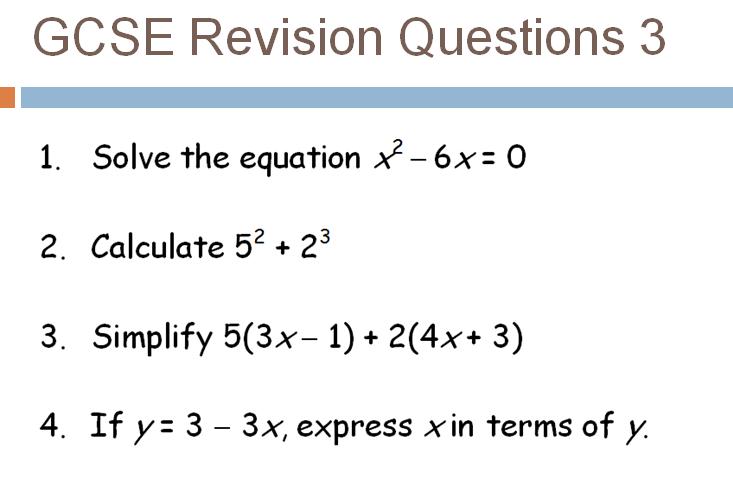
STARTER: Have a go at These 4 Revision Questions

LESSON: Use this MyMthas Lesson to practice rearranging equations of increasing difficulty

Extra Questions Page 427 - Q13 onwards of Higher GCSE Text book

EXTENSION: Use this Mymthas Lesson if above becomes easy

PLENARY: Checking answers, looking at past exam paper questions, looking at questions in papers attempted that were missed out previously


Wednesday, 2 November 2011

Thurs Nov 3rd – Mock Exam Paper

Students to work through March 2011 Unit 2 Higher paper in exam Conditions

Tuesday, 1 November 2011

Weds Nov 2nd – Revision Using Practice Paper 3 Questions

LEARNING
OBJECTIVE: Analysis and revision from Practice Paper 3

SUCCESS
CRITERIA: All understand how marks were allocated and understand how to tackle and answer level B A and A* questions

STARTER: Have a go at These 4 Revision Questions

LESSON: Work through Exam Questions From Practice Paper 3 exam paper, explaining how marks are allocated, errors that were made.. Where appropriate give students other example questions to have a go at

PLENARY: Checking on Student confidence

Monday, 31 October 2011

Tues – 1st Nov – More work on real Life Graphs / Review of Algebraic Fractions

LEARNING OBJECTIVE: To understand and interpret results from a Distanvr time graph, and be able to add/subtract algebraic fractions

SUCCESS CRITERIA: You will understand how to work out average speeds, distance travellend, time taken from Distance time graphs and be able to simplify algebraic fractions questions

STARTER: Continue working through Ex 21B on Page 461. – 25 mins max!

LESSON: Revision of adding and subtracting algebraic fractions

Use q1 page 536 of Higher text book as examples – students to work through Q2 & Q3 themselves

If too easy Jump to Q5 onwards

EXTENSION WORK: Level A* questions on page 538

PLENARY: Checking Answers, look at Practice paper three Algebraic fractions question

Sunday, 30 October 2011

Mon 31st Oct – Real Life Graphs

LEARNING OBJECTIVE: Discover how to interpret Distance time graphs

SUCCESS CRITERIA: You will be able to read real life information from Distance time graphs and understand how the gradient of a line represents the average speed between two time points

STARTER:

  1. Change 15 metres per second into kilometres per hour
  2. Change 24 kph to metres per minute

LESSON: Use this Lesson to get over initial ideas of real life graphs

Have a go at Ex 21 A on page 458 of Higher GCSE text Book – (15/20 mins)

PLENARY: Use answers in back of book to check

Have a 5 min discussion on IWB on how gradient of a line on a distance time graph represents average speed.

Have a go At Ex 21B on Page 461

PLENARY: Checking answers

EXTENSION: Q1, 2, 3, 4 & 5 on page 465

Wednesday, 19 October 2011

Thurs 20th Oct – More Revision from Mock Exam

LEARNING
OBJECTIVE: Analysis and revision from Mock Exam

SUCCESS
CRITERIA: All understand how marks were allocated and understand how to tackle and answer level B A and A* questions

STARTER: Have a go at These 4 Revision Questions

LESSON: Work through Second Half of Exam Questions From June 2011 exam paper, explaining how marks are allocated, errors that were made.. Where appropriate give students other example questions to have a go at

Extra Question

If x ¤ y = 3x + 2y

Work out

  1. 2 ¤ 4
  2. -3 ¤ -2.5

If a § b = a2 + 3b - 5 Work out

  1. 2 § 5
  2. 1.5 § -4

Hand out Practice Paper 4 for Half-Term, start questions if any time left.

PLENARY: Checking on Student confidence

Tuesday, 18 October 2011

Weds Oct 19th – Review of Mock Exam Questions

LEARNING OBJECTIVE: Analysis and revision from Mock Exam

SUCCESS CRITERI: All understand how marks were allocated and understand how to tackle and answer level B A and A* questions

STARTER: Have a go at These 4 Revision Questions

LESSON: Work through Exam Questions From June 2011 exam paper, explaining how marks are allocated, errors that were made.. Where appropriate give students other example questions to have a go at

PLENARY: Checking on Student confidence

Monday, 17 October 2011

Tues 18th Oct – More revision on Solving Inequalities

LEARNING
OBJECTIVE: Discover how to solve inequalities when there are negative values involved.

SUCCESS
CRITERIA: You will be able to solve inequalities when the variable is a negative

STARTER: Solve these Inequalities, then these inequalities

LESSON: Use questions above to show how to solve inequalities

Now have a go at these questions

PLENARY: Checking answers, looking at past exam paper questions from Exam Pro